By Bermet Borubaeva and Lucia Direnberger.
Together with artists, activists, scientists, citizens, and thinkers, the Trash Festival wants to be a platform that explores methodologies for addressing political ecology through artistic practices, art interventions, installations, research and publications in Kyrgyzstan. As Bermet Borubaeva wrote it, ‘the Trash Festival’s primary goal is to show that ‘WASTE DOES NOT EXIST, it is our modern consumer culture that creates it. We do not need to fight against landfills; we need to change the system of production and consumption.’[1] Since 2009, the festival has addressed the issue of toxic landfills, smog, pollution of soils and waters, deforestation, while creating a space where different actors collaborate to share and experience ecological solutions for greater social justice. This text is based on an interview of Bermet Borubaeva, co-founder of the Trash Festival, conducted by Lucia Direnberger in August 2026.
From Discovering Social Engaged Art to Creating the Trash Festival
In the early days at the ArtEast School for Contemporary Art in Bishkek, founded by Muratbek Djumaliev and Gulnara Kasmalieva, a group of young students began exploring the intersection of art and activism in 2009. At the time, environmental concerns were not yet widely publicly discussed in Kyrgyzstan. The collective was deeply inspired by Joseph Beuys’ 7,000 Oaks, a project initiated at documenta 7 in Kassel, Germany, in 1982. Beuys had 7,000 basalt stones piled on Friedrichsplatz, the main square of Kassel, and each stone could be removed only when an oak tree was planted next to it; the last tree was planted in 1987, at documenta 8. By the time the Soviet Union dissolved in 1991—just nine years after the project began—the geopolitical landscape had transformed, leaving the post-Soviet republics to navigate a new reality.
This inspiration led to the creation of the Trash Festival in 2009, a student-led initiative that quickly grew into a platform for ecological activism. The festival was not just an artistic endeavor but a call to action, pushing local authorities to address environmental issues. For instance, during the first edition, the group organized a cleanup of a heavily polluted river Ala-Archa. Initially ignored by the city, their persistence forced the Ministry of Emergency to intervene, highlighting the power of collective action.
The festival also became a space for collaboration with emerging ecological organizations like Move Green and Archa, which focused on green zones and plant conservation. These early efforts, though modest, demonstrated how art could mobilize communities and challenge authority. However, the festival paused after its second edition in 2010, as I left to pursue studies in Moscow.
Engagement Through Experience. From Kitchen to art in the Service of Ecological Justice
The time I spent in Moscow was transformative. While pursuing a master’s degree in Political Science with a focus on urban environment, I delved deeper into ecological and social justice issues. One of my crucial projects was the following performance: for one month, I survived solely on leftover food, exposing the staggering waste of resources: 30 to 40% of food produced globally is discarded.
But the most eye-opening experience came from working undercover as a cook at Le Pain Quotidien, a Belgian café chain in Moscow. Behind its sustainability branding, the reality was stark. The café donated only bread to charity, discarding expensive items like salmon pies due to arbitrary “safety” concerns.
Workers were divided by race: people from Russia or Belarus worked in visible roles, such as at the front desk or as waiters, while Central Asian people—especially from Uzbekistan, Kyrgyzstan, and Tajikistan—were relegated to invisible roles, working as cooks, delivery staff, or cleaners.
Migrant workers faced unregistered contracts, wage theft, and intimidation. After documenting these abuses, I published an article in newspaper Labour. As a consequence, the company regularized contracts and raise wages for 500 employees—a small but significant victory. Yet, the risks were real. After confronting management about labor rights, I faced threats.
On one hand, I was a migrant worker, but on the other, I had also completed my studies at the High School of Economics in Moscow and my master’s degree was focused on urban environment and bike-sharing systems. After that, I worked as a curator of international exhibitions and an ‘artist in residence’ at Fabrika, a center for contemporary, visual art, and creative industries in Moscow. There, we collaborated with EcoCup festival doing the performance of waste cooking and also screened documentaries about the environment. The documentary film WasteCooking showed that the 30-40% of food we are wasting that have turned also into political art practices.
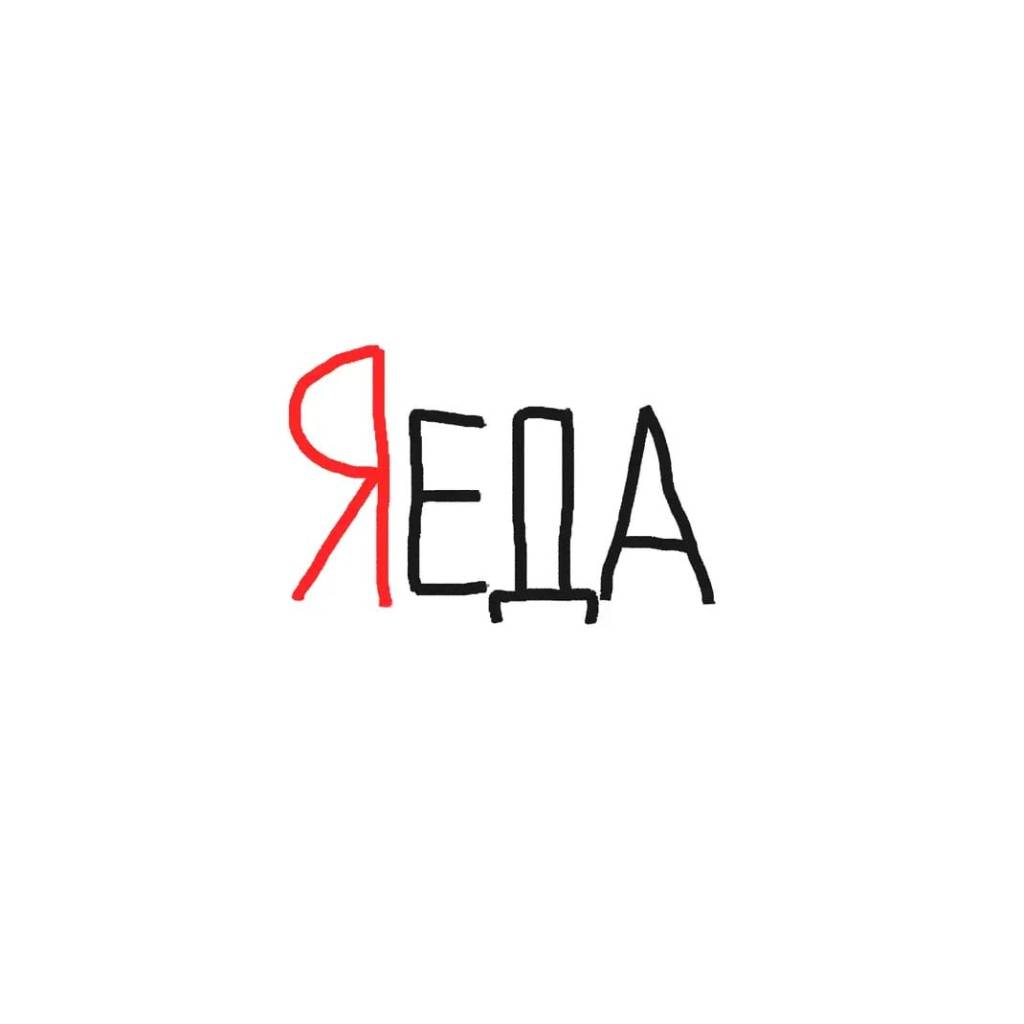
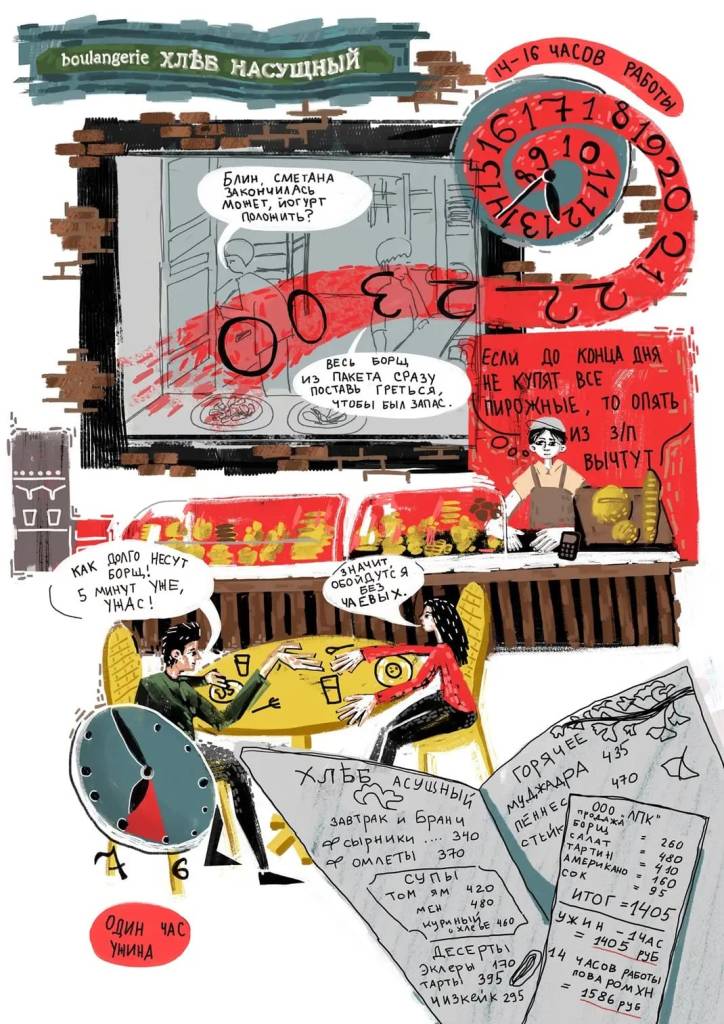
This experiment led to a comic I Am Food (Я – Еда) and collaborations with cafes and shelters to redistribute surplus food in Bishkek.
Returning to Bishkek in 2019 after six years in Russia brought another shock: the city’s air pollution had become the worst in the world. This revelation spurred immediate action. Founding #BishkekSmog, we organized protests and began documenting the crisis.
Around the same time, I participated in Feminnale, a feminist exhibition at the Fine art Museum Gapar Aitiev, with Third Shift, an edition of I Am Food, which depicted the triple burden faced by migrant women: work shifts, migration challenges, and unpaid domestic labor. The Feminnale was attacked by nationalist and masculinist groups. It was a dangerous situation. We had some kind of assembly, and we were trying to protect ourselves, our work, museum workers and our exhibition together. The situation was very, very bad—it was like fascism was rising. I really wanted to find a way to oppose it. So I started asking my colleagues: “Let’s restart a contemporary art school.” I wanted to restart it because our education in contemporary art provided by Murat Djumaliev and Gulnara Kasmalieva had given us a lot of critical thinking. And yes, this critical thinking was the tool I knew to oppose what was happening. It was just the only option available to me, and my colleagues kindly agreed to restart the school which after became the Bishkek school of Contemporary Art in 2020.
We also restarted the Trash Festival, this time with Aimeerim Turusalieva (co-founder of Tazar association) as a co-organizer. The fifth edition (2022) focused rethinking on the history of pollution, addressing air quality, plastic waste, textile waste, and the hidden costs of industries like crypto mining and hydropower stations, which devastate rivers and local ecosystems. The festival also highlighted intersectional connections between ecology and feminism. For instance, pollution disproportionately affects women in the Global South, while industries like Chinese oil factories in Kara-Balta have been linked to health crises, including cancer and miscarriages.
Art as a Tool for Transformation. The Trash Festival, Between Subversion and Solutions
The Trash Festival has evolved into a platform that goes beyond raising awareness. It demands systemic change by involving governments, proposing solutions, and centering marginalized voices. Unlike passive illustrations of environmental issues (e.g., “Look, the glaciers are melting”), the festival pushes for accountability and offers tangible alternatives. For example, during the third edition (2021), the team transformed a shop into a library, organized eco-tours, and published a zine—all on a shoestring budget of $2,000. The fifth edition (2023) in collaboration with CEC ArtsLink featured 40 events in one month, including workshops, screenings, and a small documentary, with seven curators and 100 participating artists (some waiving fees to support the cause).
A key strategy has been forcing institutional involvement. During the first festival, authorities cleaned a polluted river only after the group began doing it themselves. For the fifth edition, the city provided free machinery to prepare land for a playground in the Altyn-Kazyk district, near a landfill. The festival also opened a Trash Museum in collaboration with artist from New York sTo LEN at the landfill, blending art and activism to highlight waste management failures.
Yet, challenges persist. Funding is unpredictable—grants from organizations have been inconsistent. The team often relies on small donations, volunteer labor, and in-kind support. Documentation (videos, publications) has been critical to preserving the festival’s legacy, with collaborations like those with filmmaker Iskender Aliev ensuring that the projects remain visible and impactful.
Looking ahead, the next Trash Festival will focus on textile waste, a pressing issue tied to Kyrgyzstan’s nomadic heritage and the global fast-fashion crisis. The organizer also advocates for sustainable tourism, supporting eco-friendly hotels, and promoting alternative technologies, such as rainwater harvesting (as seen in a Colombian university) or organic cooling methods to replace energy-intensive air conditioners. The 8th edition is planned in collaboration with guest curators Charles Esche and Gluklya Natalia Pershina-Yakimanskaya, who will bring together initiatives such as the textile leftover cooperative, the museumification of Rest, and a staging of the fairy tale Sparkling Mountain by Altyn Kapalova, produced by BiSCA & Tazar in collaboration with Berlin-based actress and theatre director Mareike Wenzel.
What is often left unspoken now are topics like mining—gold, coal, and especially crypto mining. It’s very difficult to gather data, and it can be dangerous to investigate. For example, Bitcoin mining farms consume enormous amounts of electricity to sustain the crypto market, and this is deeply connected to energy issues. Our rivers are a treasure, but they are being spoiled by mini hydropower stations used for bitcoin mining farms.
Another issue that isn’t widely discussed in the public sphere is car pollution, which is extremely toxic. It’s not just about PM2.5 particles—there are also other dangerous chemical pollutants that remain unregulated. It affects the fetus and the baby inside the mother’s womb, showing a clear negative correlation. With the increasing number of cars, this problem is only getting worse. Municipal bike-sharing programs are one way to reduce pollution, as people could use them for free. In my master’s dissertation, I studied bike-sharing in Moscow and found that it was actually very expensive. For instance, if you rent a bike for a week, you could buy one outright with the same amount of money. We could think about a free bike-sharing system which would be a solution for reducing the pollution and promoting health mobilities.
Ultimately, the message is clear: ecological change cannot happen without addressing power structures. The Trash Festival embodies this by asking critical questions: Who is making the decisions? Who is causing the pollution? Who is suffering the most? It’s impossible to change the environmental situation without addressing power relations. Art can raise political questions and push people to preserve our already fragile ecological balance.
[1] Bermet Borubaeva, Aralash N°6, 2021, page 8, https://bishci.com/article/aralash-6-katalog-ekologicheskogo-festivalya-trash-3
To quote this text: Bermet Borubaeva and Lucia Direnberger, 2026, ‘Waste does not exist; it is our modern consumer culture that creates it’. Trash Festival, ecology and social justice, MAJIC – Memories, Arts and Social Justice in Central Asia, https://majic-project.net/2026/11/02/waste-does-not-exist-it-is-our-modern-consumer-culture-that-creates-it-trash-festival-ecology-and-social-justice/

