By Dilda Ramazan.
On May 5, 2026, on the eve of the opening of Kazakhstan’s third national pavilion at the Venice Biennale—and on the birthday of artist Äsel Kadyrkhanova, one of its official participants—it became known that her work Machine (2013) had been censored.
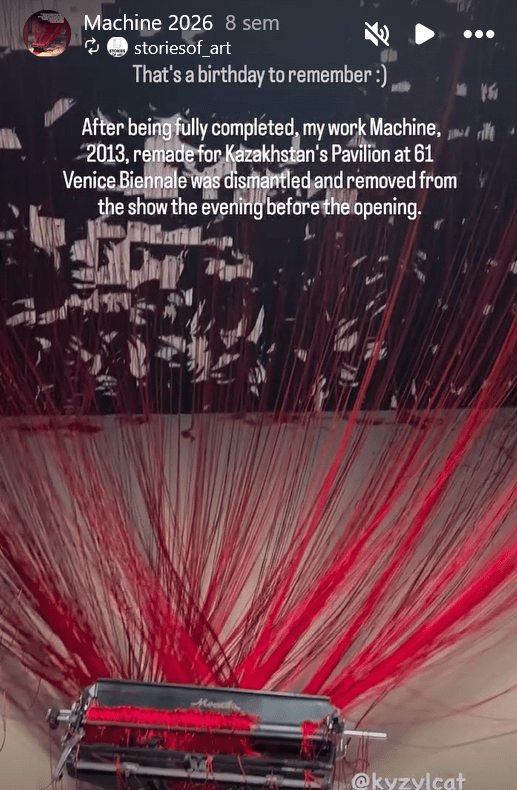
The multimedia installation, consisting of a typing machine from which multiple red threads extend, connecting the device to copies of archival documents relating to victims of the Red Terror and Stalinist repressions in Kazakhstan, was removed from display. The artist herself announced this on her social media page; this is how I first learned of the incident.
Screenshot of Äsel Kadyrkhanova’s Instagram story posted on May 5,2026.
At the official inauguration of the pavilion, which I attended the following day, on May 6, the incident was not addressed in any way. The exhibition was presented as a complete and coherent whole, despite the removal of one of its key works. Only after speaking with other participants did it become clear that Machine (2013) was no longer included in the final display, and that the space it had occupied had been rearranged and concealed behind a black curtain.
This silence left a profound impression on me—not only because a specific work had been removed, but because the act of its removal itself appeared to have been deliberately excluded from public discourse. In Pierre Nora’s terms, this situation might be understood as a conflict between memory and its institutional fixation: what was intended to function as a site of memory instead became a space of erasure and silence.
For the first time in the history of Kazakhstan’s participation in the Venice Biennale, the curatorial project was selected through an open call, successfully passing a two-stage review process conducted by a special committee and receiving preliminary approval from Kazakhstan’s Ministry of Culture and Information. Authored by Syrlybek Bekbota, the winning proposal for the 2026 national pavilion was titled Qoñyr: The Archive of Silence.
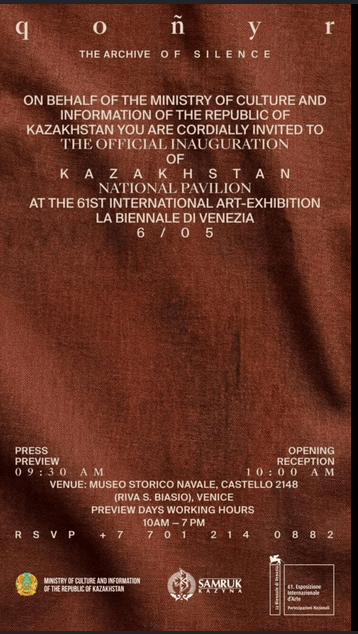
Official invitation to the inauguration of Kazakhstan pavilion
The project was conceived around the notion of an “unspeakable archive”—one marked by significant lacunae and absences that are not accidental, but rather the result of systematic practices of silencing inherited from decades under the Russian and Soviet imperial domination. Kadyrkhanova’s work, however, was part of the curatorial proposal from the outset.
The most immediate question raised by this act of censorship concerns the reasons behind the dismantling of Machine (2013). According to available information, Kadyrkhanova’s work had been approved both by the expert committee that reviewed the curatorial proposal and by the Ministry of Culture and Information of the Republic of Kazakhstan. Moreover, this was not a new or untested piece: it had previously been exhibited within Kazakhstan, including in the exhibition 1937. Territory of Memory. Joqtau at the Kasteev Museum in Almaty in 2013, and later internationally as part of the state-supported project Focus Kazakhstan in London in 2018. In other words, Machine (2013) was already embedded within an institutionally recognized framework and did not emerge as an unforeseen or disruptive gesture.
For this reason, its removal cannot be understood as a neutral or technical decision. Rather, it signals a shift in the regime governing what can be publicly articulated in Kazakhstan today about Stalinist repression and the Red Terror. Jan Assmann’s framework is particularly relevant here: cultural memory does not simply preserve the past, but actively regulates it through selection, omission, and suppression, often via mechanisms of censorship, substitution, and manipulation. The issue, therefore, is not only why this specific work was removed, but which version of the past is now deemed acceptable for public representation.
If the state previously supported the commemoration of victims of repression as part of an official narrative, the present situation suggests a reconfiguration. Under Nazarbayev, Kazakhstan could, at least on a declarative level, integrate Stalinist repression and famine into its politics of memory. The current context, by contrast, appears more cautious toward artistic practices that render these histories too explicit. In this sense, the censorship of Machine (2013) constitutes not only an artistic event, but also a mnemonic one: it reveals the boundaries of what may be remembered in the present-day Kazakhstan and what must remain obscured.
Equally significant is the gesture of censorship itself—its execution, its non-discussion, and the curatorial narrative surrounding it. This silence unfolded within a project explicitly dedicated to the violent silencing of the past, thereby paradoxically enacting the very condition it sought to expose. In this respect, the Venice Biennale cannot be understood merely as an exhibition platform; it is a site of national representation where artistic production operates at the intersection of local and global political contexts. According to the Biennale’s procedures, the curator of a national pavilion bears responsibility not only for its artistic direction and scenography, but also for its realization, accompanying materials, and overall public articulation. The curator is thus not only a conceptual author, but also an institutional agent.
It is precisely for this reason that the removal of a work without public explanation calls into question not only a singular decision, but the very logic of curatorial practice. A national pavilion presupposes a curator capable of mediating conflicts between artists, institutions, and state frameworks. When such conflicts are not addressed but concealed, the curatorial function risks being reduced to mere scenographic and administrative management. What is then at stake is not curatorial strategy, but the failure of mediation.
Particularly problematic in this context is the overlap of curatorial and artistic roles within a single project, as in the case of Syrlybek Bekbota. Known primarily as a multidisciplinary artist within the Kazakhstani art scene, Bekbota assumed the role of curator while also presenting his own work in the pavilion. While such dual positioning is not unprecedented in art history, combining these roles within the same project raises clear concerns. It creates a structural conflict of interest and risks producing an uneven distribution of visibility, authority, and critical distance. In Qoñyr: The Archive of Silence, Bekbota not only developed the conceptual framework but also included his own video installation, thereby complicating the curatorial position.
When one participating artist’s work is removed while the curator’s own work remains on display, questions inevitably arise regarding responsibility, authorship, and symbolic capital. This does not necessarily imply intentional bias, but it does call for critical scrutiny. From the perspective of institutional critique, such a configuration sharpens the question of who is authorized to speak on behalf of the nation, and who determines the limits of that speech.
The issue of funding further intensifies these concerns. The pavilion was supported by the Ministry of Culture and Information of the Republic of Kazakhstan and the state-owned corporation Samruk Kazyna, meaning it was realized with public funds. This renders the project subject to public accountability. If an artwork was removed, if the exhibition remained incomplete, and if even basic informational materials were absent at the opening, then the problem is not only artistic but administrative: how were resources allocated, and who bears responsibility for the final outcome?
In this context, Pierre Nora’s insight becomes particularly pertinent: memory becomes most vulnerable when it is artificially sustained through archives, commemorations, and institutional frameworks. The national pavilion functions precisely as such a constructed site of memory. Yet when it is simultaneously state-funded and marked by the unexplained removal of a key work, it ceases to operate as a space of memory and instead becomes one of administrative opacity. The question of funding is therefore not secondary; it directly concerns the mechanisms through which the state materializes, regulates, and constrains public memory.
The response to the incident was, unsurprisingly, polarized within the Kazakhstani art scene. Part of the artistic community expressed support for Äsel Kadyrkhanova, notably through an open letter that sought to draw attention to what was perceived as an unjustified and opaque act of censorship, while others defended the organizers, curators, and participating artists. Yet this division, in my view, cannot be reduced to a simple clash of opinions. Rather, it exposes the fragility of artistic solidarity in conditions where information remains opaque and institutions privilege silence over public accountability.
It is precisely here that the dynamics of cultural memory become particularly legible. When the public archive is incomplete, when facts are not clearly articulated, and when responsibility is diffused, the space of discussion is quickly overtaken by affective allegiances, suspicion, and moral polarization. The debate thus shifts away from censorship as such toward questions of belonging: who is aligned with whom, who is entitled to speak, and who is implicitly expected to remain silent. This dynamic closely echoes Jan Assmann’s notion of the suppression and substitution of memory: the removal of a single work initiates a broader process of reconfiguring public narrative.
For me, the central issue is not only why Machine (2013) was removed, but how its removal could occur without immediate public explanation. It is within this silence that the most revealing gesture resides. It suggests that even within a national pavilion ostensibly dedicated to artistic expression, memory may not simply be represented—it can be actively annulled.
To quote this text: Dilda Ramazan, 2026, “Canceled memory, censored art: on Kazakhstan pavilion at the 2026 Venice Biennale”, MAJIC – Memories, Arts and Social Justice in Central Asia, https://majic-project.net/2026/07/08/canceled-memory-censored-art-on-kazakhstan-pavilion-at-the-2026-venice-biennale/

