By Aizhamal Biigazieva and Lucia Direnberger.
In 2024, Kyrgyzstan adopted amendments to its “child protection law,” restricting the dissemination of information about diverse sexual orientations and gender identities. This measure mirrors Russia’s 2014 anti-LGBTQ+ laws. In this repressive context, Aizhamal Biigazieva, a member of the feminist and queer collective Qun Jelesi (Rainbow in Kyrgyz), curated two significant exhibitions: Квирбиз – Эркинбиз (“We Are Queer, We Are Free“) in 2023 and Аста, Аста (“Slowly, Slowly“) in 2025. These projects highlight the struggle for visibility and queer joy in a hostile environment. This text, based on an interview with Aizhamal by Lucia Direnberger in 2025, explores the challenges, strategies, and successes of these exhibitions, where art becomes a tool of resistance and celebration for the queer community in Kyrgyzstan.
Квирбиз – Эркинбиз. React and normalize
In 2024, Kyrgyzstan adopted a law against “queer propaganda,” with implementation beginning as early as August 2023.
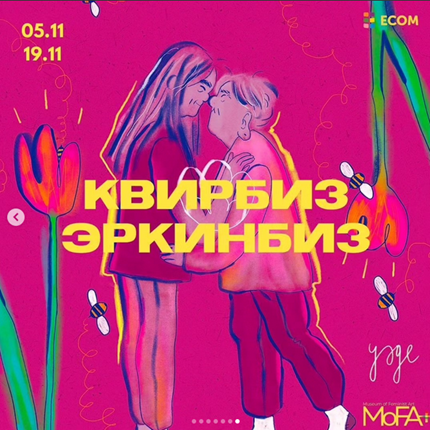
In response to this legislation, I decided to curate a queer exhibition titled Квирбиз – Эркинбиз, which means “We Are Queer, We Are Free” in kyrgyz. The exhibition centered on the theme of queer love, aiming to highlight the humanity of queer individuals in the face of discriminatory laws and hate speech.
The concept of the exhibition was to showcase that queer people often have to create their own worlds due to societal exclusion. Yet, these worlds are not so different from anyone else’s. We, too, have people we love, favorite foods, cherished activities, and moments of joy and sorrow. We experience grief, love, sadness, and happiness just like everyone else.
Through this exhibition, my goal was to normalize being queer. We are not abnormal or separate—we live ordinary lives, filled with the same emotions as anyone else. The artists contributing to the exhibition shared deeply personal stories: some spoke about their first love, others about the experience of being loved, and some addressed the challenges of censorship. Together, we sought to humanize queer identities and assert our place in the world.
My first queer exhibition holds a special place in my heart because I poured my thoughts, emotions, and passion into it—all with a modest budget of just $1,000. It took place in Bishkek’s City of Artists, a historic space dating back to Soviet times. During the USSR era, this place was a vibrant hub for artists and exhibitions. However, today, it has fallen into disuse due to its aging infrastructure. To sustain itself, the association renting the space has begun leasing small offices, giving the building an almost residential appearance, with each room having its own door and lock.
I discovered this unique space and rented it for a month to host my exhibition. Though it was tiny—just 15m²—I maximized every inch of it. The exhibition featured 12 artists from across Central Asia, including participants from Kyrgyzstan, Kazakhstan, and Karakalpakstan in Uzbekistan. I still don’t know how I managed to pull it all off with such limited funds, but somehow, I did.
This was Kyrgyzstan’s first open queer exhibition, and it wouldn’t have been possible without the incredible support of Altyn Kapalova. It was challenging, but every effort was worth it. The exhibition ran for two weeks, marking a small but meaningful step toward visibility and acceptance.
Аста, Аста. How to find a safe place for Queer artists ?
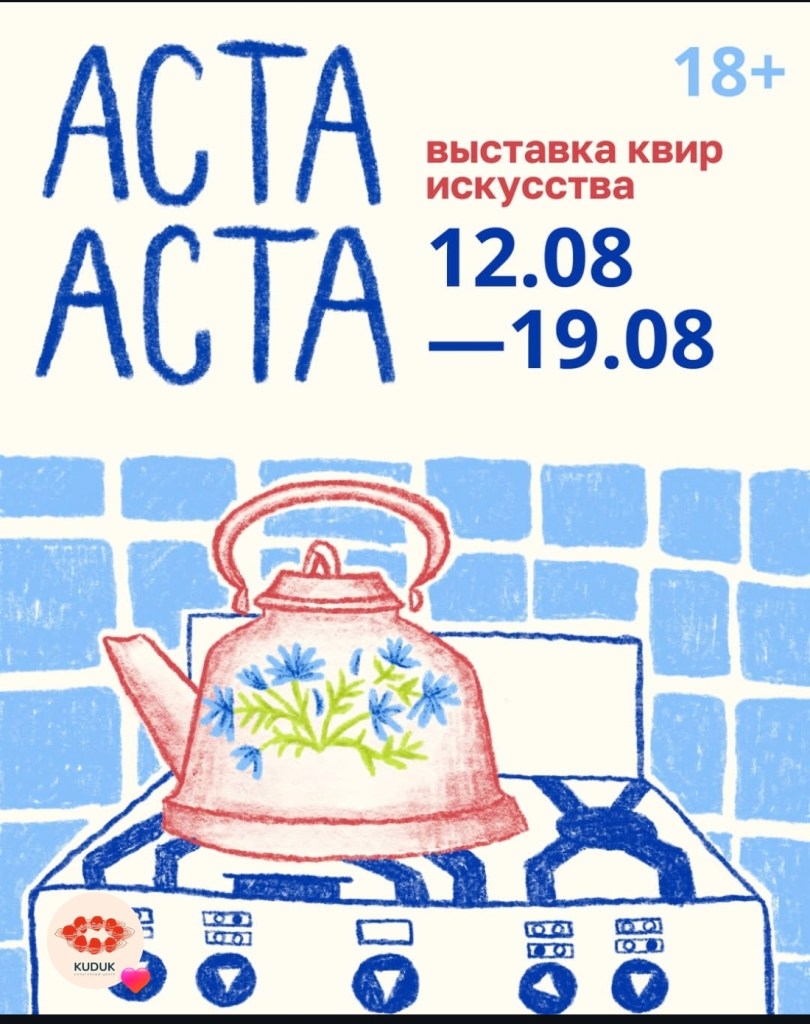
In 2025, with the feminist queer collective Qun Jelesi (“rainbow” in kyrgyz), Zhanno Zharmatova – curator and artist – and me curated the exhibition Asta, asta. Asta means “slowly” in kyrgyz. We chose this word, because it truly describes how we are seeing queer life in Kyrgyzstan now, because we can’t really be loud, we can’t be very expressive, we can’t be seen.
We had like few queer clubs and they are closed down because of the hate and safety reasons. So we think queer community in Kyrgyzstan are living by the credo, asta asta. The theme of the exhibition was Queer joy. We wanted to talk about the small joyful moments of queer people in Kyrgyzstan. Being a happy gay person in Kyrgyzstan is considered a protest.
The main challenge was finding a suitable space. State spaces were out of the question because they would subject us to censorship, forcing us to change almost everything. We already face enough censorship without adding another layer. So museums were closed to us, even if some directors might be allies. They were too afraid to collaborate with us due to the laws. Private museums were either too expensive or equally inaccessible.
We then turned to hotels, which often have unused spaces like conference rooms or parking areas. However, we couldn’t make any adjustments—not even the lighting. We could bring paintings, but we could only place them on tables or similar surfaces. We couldn’t hang anything, and we don’t believe an exhibition is effective if you can’t hang what should be hung.
Next, we explored commercial spaces and found many options, but they were either in inconvenient locations, too crowded, or too far from the city center. We wanted a space that was accessible to visitors, as people wouldn’t travel far to attend. It was also too expensive.
Finally, we considered renting houses. We thought, if museums, hotels, and commercial spaces weren’t viable, maybe a house would work. It would be easier to prepare, safer, and more welcoming for visitors—not just to view the exhibition but also to sit, have tea, and connect with us. However, finding a short-term rental was difficult. Eventually, we found an apartment, and the landlady was incredibly supportive. She told us, “You can use anything. You can change anything you want. Just do whatever you need to prepare for the exhibition.”
Qun Jelesi used its social media to call for artists, sharing key dates but omitting details like the address and hours to avoid attention. The collective intentionally used the term “queer” instead of “LGBTQ+”—authorities in Kyrgyzstan recognize and often reject the latter, while “queer” remains less understood and thus less targeted.
Twelve artists were selected and worked for two months, deeply involved in preparing the exhibition. The space itself was ideal: one room had yellow walls, another blue, and even the small, unattractive kitchen was transformed into a video exhibition area. Preparations were both creative and resourceful. The team shopped at Osh Bazar, a local market known for its affordability and variety, buying lights, chairs, tables, tools, and large textile materials to cover windows. It took four days to set everything up, turning the space into something special.
To maximize the potential of every corner, they even used the toilet and bathroom as an art space. Blue-painted lights bathed the rooms in color, while funny, relatable queer memes and excerpts from important research and articles were displayed. Small, quirky chairs were added to keep the atmosphere lighthearted and approachable. Despite the challenges, they succeeded in using the space to its fullest potential.
To ensure the safety and privacy of the exhibition, Qun Jelesi used its social media account to manage visitor access. Due to censorship concerns, visitors had to message the collective directly on Instagram. I was responsible for vetting each request by reviewing profiles to confirm whether they were part of the queer community, shared common connections, or displayed any signs of hate speech or homophobia. It was a time-consuming process.
We also had to verify that all visitors were over 18 years old, in compliance with Kyrgyzstan’s law aimed at “protecting children from non-traditional values.” This often required asking for personal details, which was uncomfortable but necessary. To filter out potential homophobic individuals, I asked questions like: Why do you want to attend? How old are you? Can you share your pronouns? Since most homophobic people in Kyrgyzstan are unfamiliar with the concept of pronouns, those who knew about them were likely part of the queer community or allies.
Organizing the exhibition was an exhausting experience. For months, we lived with the constant fear that something might go wrong—whether someone would stalk our Instagram account or target the exhibition itself. Our concerns extended beyond our own safety to the well-being of the artists involved. Before beginning preparations, we held a formal safety session with the artists. We advised them not to share the exhibition’s address with untrusted individuals, to redirect any suspicious Instagram messages to us, and to avoid engaging with homophobic visitors. We emphasized prioritizing personal safety over protecting their artwork. Fortunately, nothing adverse happened, but the need for a safety plan added to our stress. By the time the exhibition ended, we were all emotionally drained. The three of us who worked on it experienced burnout, despite the event’s success and the relief of knowing everyone remained safe.
We welcomed 300+ visitors in a span of one week. The exhibition fostered a sense of belonging within the community, showing queer individuals in Kyrgyzstan that they are not alone, that they are seen, and that they are understood. With more funding, we could have included more than the 12 artists who participated.
The exhibition featured a diverse range of art, including two installations, graphic art, traditional paintings, video art, mixed media, and collages. For many of the artists, this was their first exhibition, even if they were already established in their own right. One artist had even participated in international exhibitions, while others, though active online, had never had the opportunity to display their work in Kyrgyzstan. Some had applied to open calls by other curators but were never selected. One artist created her own small games as part of her contribution.
Most of the artists chose to display their real names rather than pseudonyms. We believe this decision stemmed from the fact that queer individuals in Kyrgyzstan already face so much censorship. When given a space where they could be free, they wanted their real names to be seen and heard loud and clear. That was their way of reclaiming their identity.
To quote this text : Aizhamal Biigazieva, Lucia Direnberger, 2026, « Curating Queer Exhibitions in Bishkek. Love, Joy and Resistance », MAJIC – Memories, Arts and Social Justice in Central Asia, https://majic-project.net/2026/06/15/queer-exhibitions-in-kyrgyzstan-love-joy-and-resistance/
 MAJIC
MAJIC 