By Viktor Tsoy and Karim Hammou.
Viktor Tsoy, born and raised in Kyrgyzstan, is a graffiti artist under the name Chase and a hip-hop practitioner since almost 30 years. He is the founder of the art collective Basicolors. Ethnically Korean, his family’s story bears the mark of a little-known part of Soviet history: back in the 1930s, his grandmother’s family was deported by Stalin from the Russian Far East to the steppes of Kazakhstan. From there, his family traveled by foot all the way to the southern region of Kyrgyzstan. He himself was born in Bishkek, known then as “Frunze”, when the city was named after the famous Russian military figure. In this text, based on an interview with Viktor conducted by Karim Hammou in 2026, he shares his reflections as an artist and a hip-hop enthusiast, as well as his artistic projects. He will take part in the Hip-Hop Knowledge symposium, which will be held on October 29th and 30th at the American University of Central Asia in Bishkek.
“When the USSR collapsed, hip-hop entered my life”
I spent my childhood growing up in the Soviet Union. I’ve been drawing for as long as I can remember – ever since I was a little kid. I drew at home, then in kindergarten, then during class, after class, and sometimes even instead of class. When the USSR collapsed, hip-hop entered my life. Russian rap, and later American rap, became available to me and my boys back in school. Every single day we listened to pirated cassette tapes, listening to them until the tape got eaten by the player, and then we’d just make new copies from other copies. In high school, we started organizing neighborhood school parties. I was the DJ, and the bulk of the music I spun was, of course, rap. Later on, we started writing our own lyrics and rapping over bootleg instrumentals. That’s how poetry entered my life. As a college student in the early 2000s, I even recorded a short rap album in the university’s recording studio. It was only later, that the other elements of hip-hop – breaking and graffiti – entered my life.
I was always big into sports, so after high school, I got hooked on breakdancing. I saw huge potential for physical growth in breaking, especially in power moves. The fluidity of the dance, the acrobatic elements, and the broken beats – I just fell in love with the whole thing. I joined one of the local crews and trained hard with guys from different neighborhoods. That’s how I met the city’s first taggers. As I hung out more with the graffiti crowd, I found myself getting back into serious drawing, which I had never really dropped anyway, even during my peak breaking days. Connecting with writers gave me the motivation to dedicate more time to graffiti.
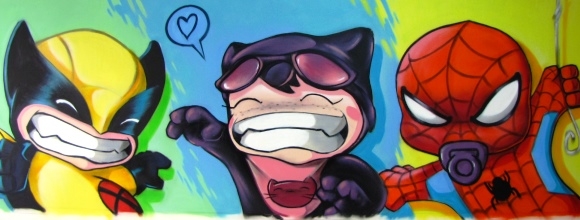
We started Basicolors back in 1998. The name of my crew came about in the late ’90s when we first started painting graffiti using no-name spray cans from China. The color palette was super limited – there were basically no shades or gradients, so we could only paint with the primary colors. That’s how we came up with the name Basicolors – it was as simple as that. Back then, it was just a small group of guys trying to figure out what graffiti even was and how to start painting. In the early 2000s, the crew transitioned into an art collective. By that time, we already had experience painting large-scale graffiti and had built connections with city officials and international funds. We began teaching youth how to paint and running art projects aimed at developing urban public spaces. Our main goal was to showcase the aesthetic value of street art and bring fresh faces into the scene.
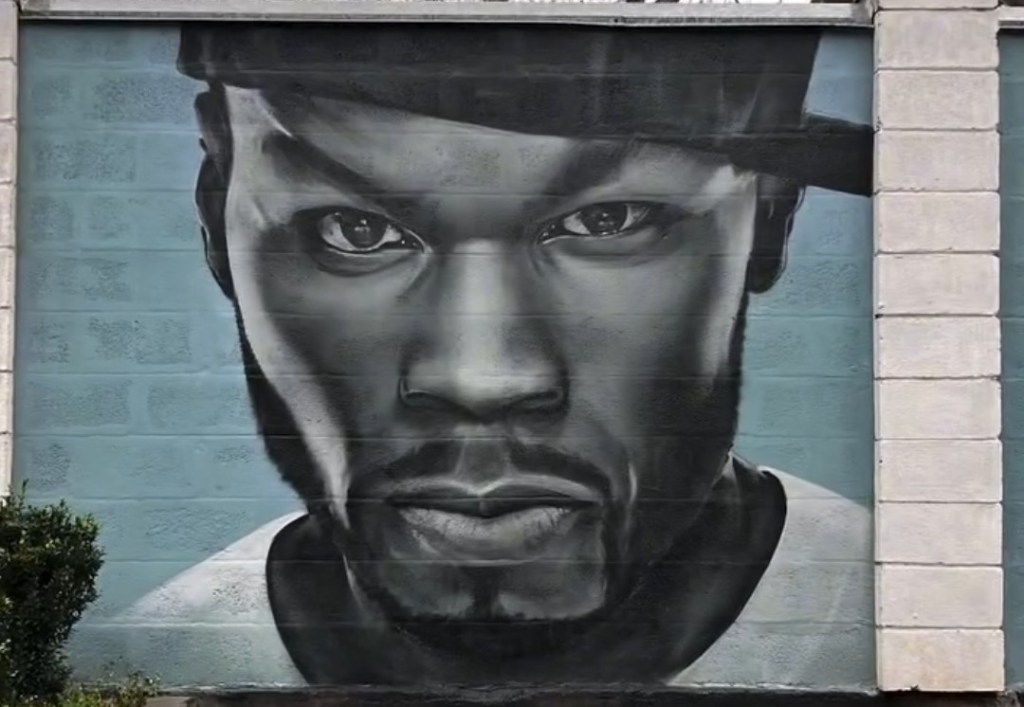
Anime and rap have been with me from the very start, and they heavily influenced my art. If you look at my early work in the 2000s, it was exclusively graffiti featuring anime characters. After spending a long time painting photorealistic portraits, I’m now gradually moving toward simplifying my style. I’m partially returning to anime, but not in its pure form. I’m trying to find that sweet spot between photorealism and cartoon style. It’s starting to come together, and it makes me really happy. I see simplification as a natural progression. First, we want to complicate everything and pack in as many details as possible, but over time, we strip away the excess. Just like in real life.
Separate subcultures with a faster growth
Recently, the hip-hop industry started booming in the region, and has also become kind of mainstream. I don’t think that’s a bad thing – more people got access to all elements of hip-hop, and artists from different disciplines gained recognition and the ability to grow faster. But the vibe of true hip-hop was lost for good. Commercial hip-hop brought its own pros and cons. It’s a bit of a catch: to grow faster, you need commercialization, but commercialization kills the raw vibe. Some elements are picking up steam, while others fall into the background.
The core essence of hip-hop and its old-school vibe are gone forever. Those first hip-hop festivals we had in the city carried an old-school vibe that will definitely never happen again. Technically speaking, those festivals were way weaker than what we have now, but they had that raw, non-commercial, “just for fun” energy. Dozens of guys and girls from different neighborhoods would gather to battle, hang out, spray paint, and share skills and knowledge. Everything was driven by pure enthusiasm, with zero thoughts about big money or building an industry around the subculture. Maybe that was a downside for the subculture’s growth back then, but hip-hop was real – like a flow with no autotune.
The core elements of hip-hop don’t really interact with each other the way they did in the early days. This happens naturally – each element evolves into its own separate subculture, with very few ties to the others. Again, this is a double-edged sword. On the plus side, it leads to a positive hyper-focus, meaning faster growth and development within a specific direction. On the downside, the overarching spirit of hip-hop gets diluted even more by this trend. But I believe all hope is not lost. There are still plenty of old-school heads in hip-hop who, I’m sure, would join forces if the right opportunity came along.
I’m happy to see so many big names in Kyrgyz rap now – guys whose flow and beats truly hit hard. Breaking, on the other hand, has become less active, with only a few strong dancers still making noise. In graffiti, things have stayed pretty steady – the scene isn’t huge, but the writers are active, which is great to see.
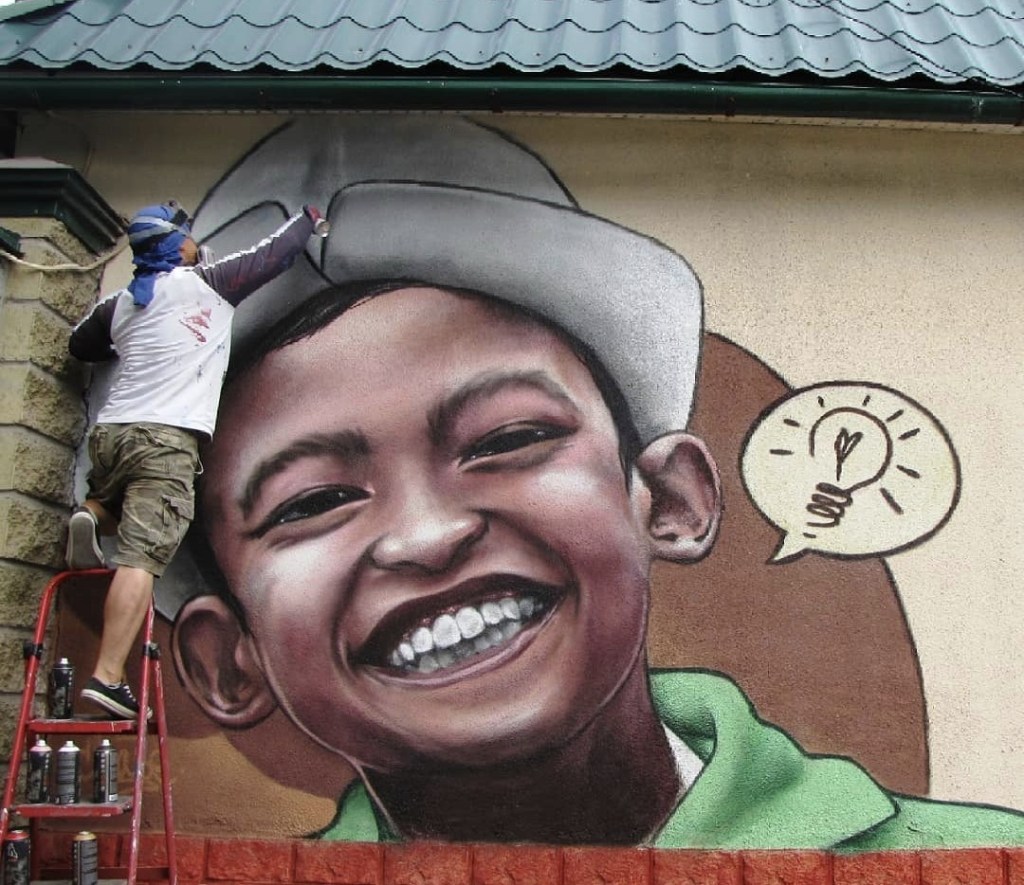
In our region, and Kyrgyzstan specifically, the problems haven’t really changed since graffiti first appeared in the country. The graffiti scene isn’t growing at all. There are a few reasons for this, the main one being the availability and cost of supplies – good paint costs real money. The second reason is how long it takes to grow as a graffiti artist. However, one thing has changed dramatically in favor of beginners: now they have free access to tutorials, and most importantly, they have people they can actually ask for advice. In the late ’90s, we had neither.
Another thing worth noting is that 30 years ago, when I started out, drawing graffiti was automatically dismissed as just messing around, as something completely unserious. Today, street art has become an integral part of the modern urban landscape. Even the city administration, which isn’t exactly known for having progressive views, understands the importance and aesthetics of urban art for public spaces.
The unifying spirit of hip-hop
It’s crucial for us not to just stay in our own little bubble. For a long time, our scene existed in isolation from global trends, far away from the rest of the graffiti world. While that gave us the space to develop independently and follow our own path, living and creating in isolation today – in the age of the internet and globalization – makes absolutely no sense. By traveling to other countries and building new collaborations, I’m not just meeting incredible people and soaking up best practices; I’m also sharing my own experience and putting my country on the map.
In hip-hop, it’s easy to find like-minded people who won’t just support you but will become your true family – if you’re willing to stay open and do more for others than what’s expected of you. Even when certain elements split off from the subculture and become independent movements or industries – like graffiti did – the spirit of hip-hop stays alive within them.
Today, when I paint in other countries, I can always hit up my friends or their friends. Whenever I land in their cities, they welcome me and get everything ready for a solid graffiti production. That is exactly how good old hip-hop works. Historically, Germany became a second home for me graffiti-wise. Back when I was a student, I did the fieldwork for my bachelor’s thesis there, focusing on “Graffiti as a Cultural Phenomenon in Germany.” I’ve been deeply connected to the country ever since. This year, I went on my very first official art tour, and naturally, it was in Europe. As part of the KYZ POWER European Art Tour – a joint project with our friends at Ak-Sai Travel – I painted murals in the Netherlands, Poland, and Germany.
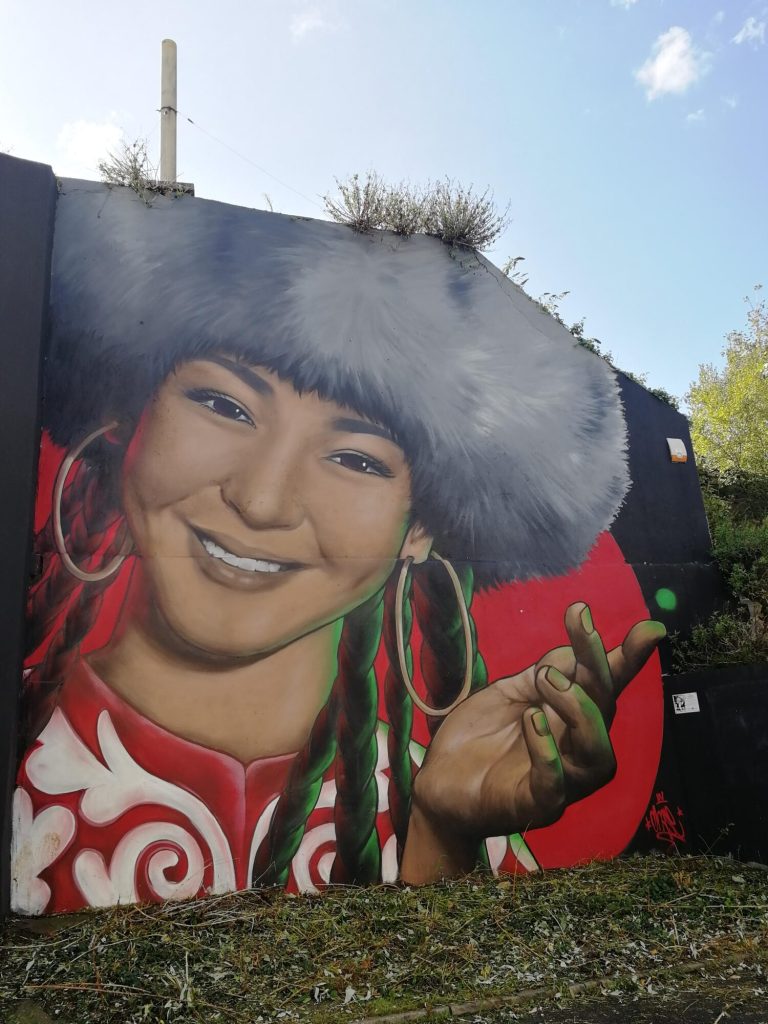
I’ve also traveled a few times to Kazakhstan, where some incredibly talented street artists are doing great work. I’m also close with artists from Uzbekistan who have visited me here in Kyrgyzstan, and I look forward to painting with them on their turf soon. Street art is booming in these countries, and I hope this energy eventually spreads to the rest of the region.
Participating in numerous jams and graffiti festivals around the world, I meet so many cool, open-minded guys and girls driven by the same passion and spirit, and it’s incredibly unifying. When you think about this side of hip-hop, compared to the state of the world where countries are trying to grab what’s not theirs, plunder, and kill their neighbors, you realize how vital this unifying spirit of hip-hop really is. When you’re in it, you realize this is real, this is genuine, and this is what’s truly worth doing and pushing forward.
Hip-hop is not just music and dancing, as people outside the culture might think. It’s way bigger than just a subculture. It’s a unifying spirit that connects millions of people worldwide with a positive goal of exchange, growth, and good energy. Back in the day, hip-hop kept me from getting mixed up in stupid youth trouble. It guided me onto the right track – the path of creation and self-development that I still walk today. A huge shoutout to all the hip-hop heads across the globe. Sometimes life makes you feel like there’s zero room left for creativity, but those are the exact moments we need to push harder and return to good old hip-hop. Because it will always give you the energy and the strength to keep going.
As long as you keep pushing your element and passing your experience down to the next generation, hip-hop will live on and keep bringing people together all over the world.
KYZ POWER – “the right to choose your own path”
Right now, I’m fully focused on expanding my initiative called KYZ POWER. It’s a street art project designed to empower and support women through art. It’s all about freedom, inner strength, and the right to choose your own path. The project started in 2022 with a mural dedicated to supporting girls and women facing difficult life situations. It sparked a massive, positive wave of feedback. Even while I was still painting it, random passersby would come up to me, learn about the message, and share their own heavy life stories. After it was finished, I got flooded with messages thanking me for the project.

That’s how the idea for the second mural was born, which was the first one to explicitly feature the name KYZ POWER (Girl Power). I painted it in 2023 on the walls of the National Museum of Fine Arts, having been invited by the museum’s management. The mural went viral instantly. It blew up across the country’s media landscape, which triggered a brutal war in the comments section. It turned out that not everyone is on board with empowering women. Things escalated so quickly that the mural was buffed and destroyed just five days later. It was heartbreaking, but it also meant one thing: the topic is vital, and I had to keep pushing it.
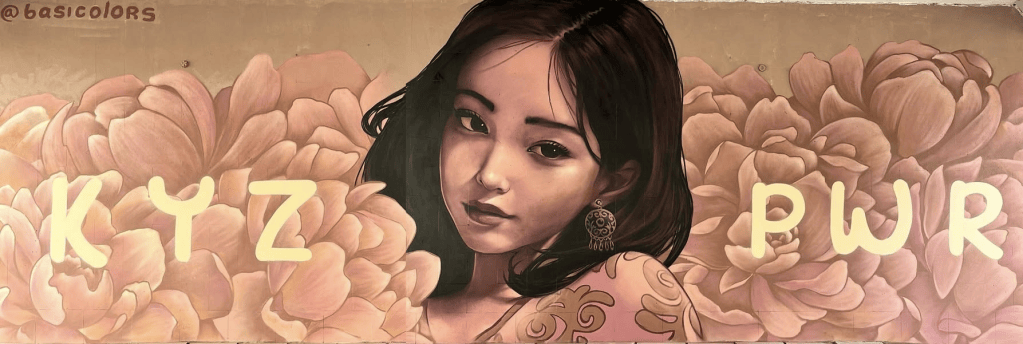
That’s how KYZ POWER became a community-based project. Now, I paint these murals in public spaces by invitation from the venue owners – cafes, hostels, and creative hubs. They cover the cost of the supplies, and I paint the murals for free. In 2024, my crew and I organized the largest KYZ POWER street art festival yet in terms of international attendance, creating a massive mural spanning over 700 square meters. Over 40 artists from all over the world flew in.
That festival was huge for us because of the sheer number of international guests. We had over 40 artists from practically every continent – South and North America, Southeast Asia, the Middle East, Central and Eastern Europe, and Central Asia. We actually received over a hundred applications globally. However, due to limited resources – as we funded the materials and the cultural program ourselves – we couldn’t invite everyone.
I am incredibly grateful to all the artists for their mind-blowing support and energy. They bought their own plane tickets just to back the message of KYZ POWER. We’re still in touch today and occasionally link up for joint projects whenever I’m in their countries. During the festival, we collectively painted a massive mural of over 700 square meters on the walls of a local mall. I also want to give a massive shoutout to the Novotel hotel and its owner for hosting an incredible farewell reception for all the participants.
Then, in 2026, I embarked on the first KYZ POWER European Art Tour, painting murals in three European countries under the unifying slogan: “You Can Fly.” Every single piece drew a lot of attention. The feedback varies, which is completely normal. Our society isn’t a monolith, so people are bound to have different opinions. The ultimate value of the project lies in its message: it’s about strength, freedom, and the right to choose your own path. This matters deeply to me because I truly believe these values can make our society better.
To quote this text : Viktor Tsoy and Karim Hammou, 2026, « Traveling Colors – Viktor Tsoy’s Path toward U.N.I.T.Y. », MAJIC – Memories, Arts and Social Justice in Central Asia,

