
By Lucia Direnberger.
Initiatives which aim to bring women’s history and experiences into museums with feminist perspectives are becoming increasingly visible in Kyrgyzstan. These initiatives are diverse and deploy different strategies in various spaces. This blog post explores how such engagement with feminist practices is reshaping museum content, introducing new themes, and challenging the mainstream definition of what a museum should be in Kyrgyzstan. By reclaiming women’s history and experiences in museums, these initiatives shed light on the dynamics of women’s movements. They also reveal the complex relationships between statte institutions and social movements—characterized by a mix a support, resistance, and repression. Focusing on recent case studies, this post examines the work of museum professionals, scholars, and artists who are pushing back against erasure of women’s histories in state and non-state museums. Their projects demonstrate how feminist interventions can redefine cultural institutions.
Create space in state museums for women’s experiences, knowledge and production
Museum workers, scholars, and artists employ diverse strategies to create space for women’s experiences, knowledge, and cultural production. One approach is curating temporary exhibitions in state museums. For example, in October 2022, the exhibition “History of Tobacco in Nookat Region: Women’s Workforce” opened at the Nookat District Historical Museum in Osh Province (Southern Kyrgyzstan). Led by Kalima Esenbay kyzy, the museum’s director, the exhibition focused on the experiences of Central Asian women, who formed the backbone of tobacco production during the Soviet era. Baktygul Midinova, director of the Regional Museum of Fine Arts of Osh (named after T. Sadykhova), and Umut Atamkulova conducted research to ground the exhibition in archival materials from Kyrgyzstan and Russia, as well as oral histories. They interviewed fifteen women who had worked in tobacco fields from a young age in the villages of Jany-Nookat, Zulpuev, and Kara-Tash.
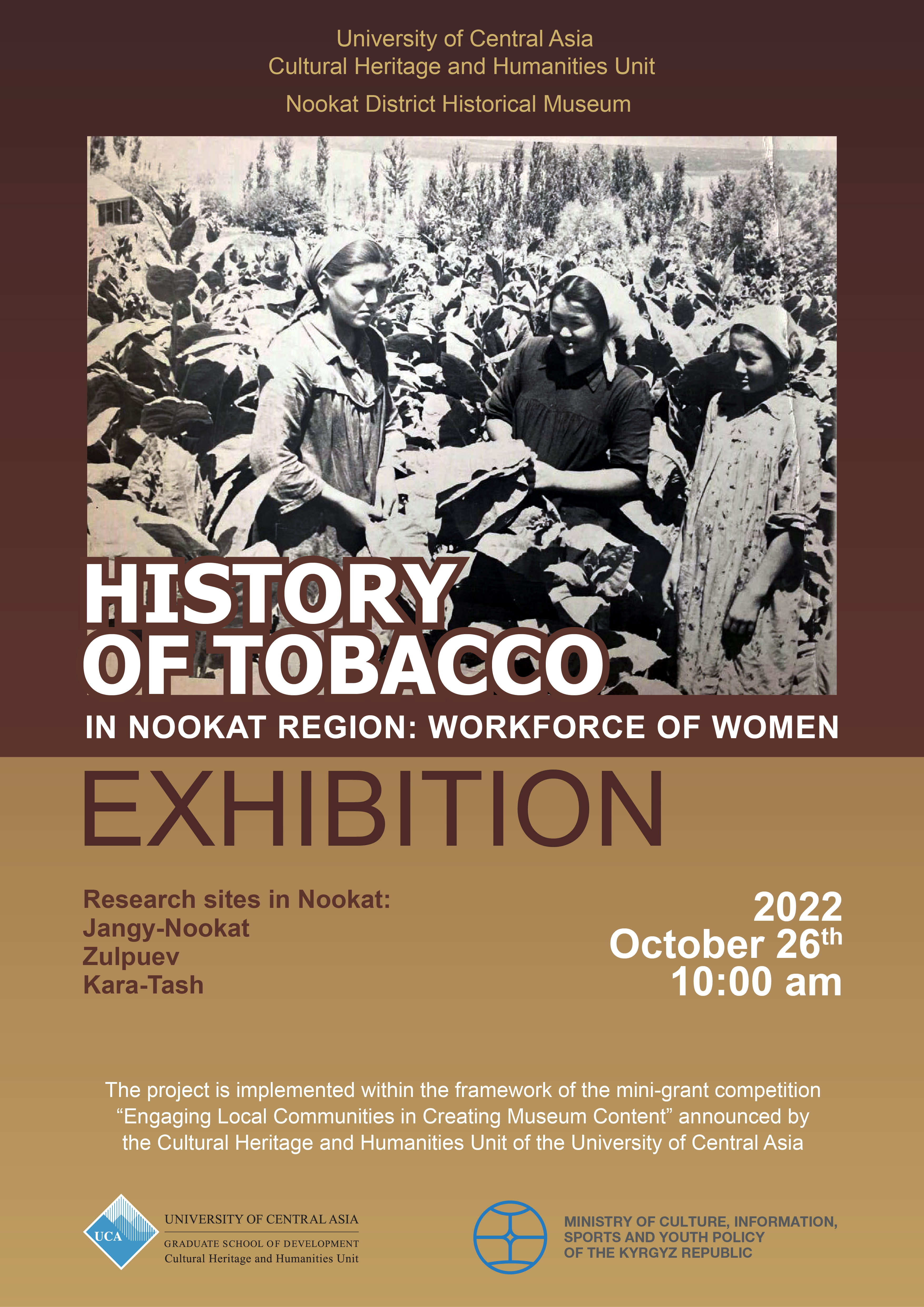
The exhibition highlighted that the Nookat District became a major center of tobacco production, since its establishment on December 24, 1928. Known as the birthplace of tobacco in Kyrgyzstan, it played a leading role in tobacco cultivation in the Kyrgyz SSR. Collective farm workers in Nookat received numerous accolades for their labor, including titles such as “Deputy of the Supreme Soviet of the USSR,” “Deputy of the Supreme Soviet of the Kyrgyz SSR,” and “Hero of Socialist Labor.” However, the exhibition revealed the harsh realities women faced beyond this romanticized narrative of hard work: long working hours, non-mechanized labor, health issues, and inadequate pay. Many children, unpaid, also participated unpaid in tobacco cultivation tasks, including harvesting and drying leaves. Midinova’s research further demonstrated that the Soviet state systematically organized this cheap labor force. Few women in Nookat had access to higher education, which could have enabled social and professional mobility. Instead, women were strongly encouraged to have large families, as access to contraception was virtually nonexistent. The amount of land allocated for tobacco cultivation was directly tied to the number of children a woman had: the more children she bore, the more land she received—and, consequently, the more tobacco she was expected to produce. Yet, this additional labor from her children went entirely unpaid. Through oral histories conducted with Central Asian women and extensive archival research, this exhibition challenges mainstream narratives about the Soviet project of women’s liberation in Central Asia. It questions assumptions regarding women’s access to healthcare and education. At the same time, it also shows that labor can be analyzed as a site of social inequalities, to the detriment of Central Asian women, rather than as an indicator of their liberation in the Soviet empire.
Another initiative to create space in state museums for women’s experiences, knowledge and production is was led by the Bishkek school of Contemporary Art (BiSCa) in collaboration with Asia Art Achive. It consists of a mobile librairy, which runs from April 2025 to June 2026 : “By circulating printed matter in the form of a travelling librairy and co-organising programmes that activate and respond to the materials, this project builds new possibilities to engage with art as a form of knowledge”. In this library books and zines circulate, some of them were published by the members of BiSCA, an organization rooted in feminist, Marxist, ecological, and decolonial frameworks which was established in 2020 to challenge dominant power structures of knowledge production. One of these productions Искусство Кыргызстана в практиках художниц ХХ века: живопись, графика, скульптура, керамика [Art of Kyrgyzstan through the practices of women artists. Painting, Graphics, Sculpture, and Ceramics] aims to decenter male-centered reconstitution of the history of Contemporary art by presenting 140 creations of 23 women artists from Kyrgyzstan – including creations from Olga Manuilova, Orozgan Mambetalieva, Chynara Torobekova and Farida Karimova. This hybrid publication – both book and catalogue– is based on a extensive research conducted at the library of the Kyrgyz National Fine Arts museum, and on a temporary exhibition entitled “The Air We Breath” curated by Diana Ukhina and displayed at the Kyrgyz National Museum of FIne Arts named after G. Aitiev. Diana Ukhina also collected archives at the Central State Archives, Socio-Political Documents Archives, privates archives of artists and interviews with artists. In a context of censorship of certain feminist works by the Ministry of Culture, Diana Ukhina undertook this project to make women artists visible. This book is part of a mobile library, allowing its dissemination in and beyond Bishkek, despite the existence of an only limited number of prints due to a tight budget. The mobile library allows the circulation of books on contemporary arts, in a context where access to books is very limited because of lack of funding.
Another recent initiative is the Second National Museum Festival of the Kyrgyz Republic, organized by feminist and queer scholar Altyn Kapalova, a research fellow at the University of Central Asia. The festival took place in October 2024 at the Kurmanjan Datka Centre of Nomadic Civilisation in the village of Örnök, Issyk-Kul region (Kyrgyzstan), in partnership with the Ministry of Culture, Information, Sports, and Youth Policy of the Kyrgyz Republic. The theme of this year’s festival was “Enhancing the Portrayal of Women and Their Narratives within Museum Spaces.” Over the course of three days, approximately 30 museum projects dedicated to the women of Kyrgyzstan were presented. Five of these projects were selected and awarded funding to implement their ideas in their respective museums.
Making visible and challenging inequalities at work
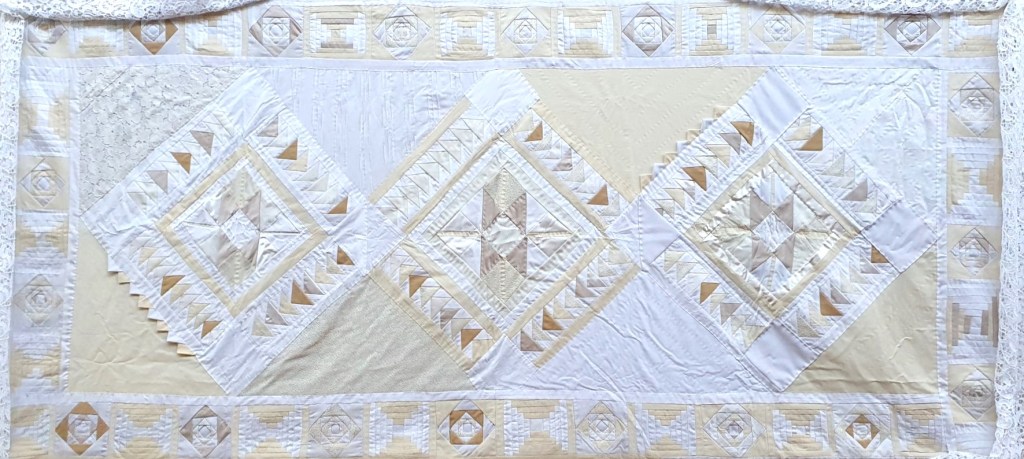
The Feminnale exhibition in Bishkek in 2019 and the “Timeless Textiles: Kurak – Piecing Together Women’s Stories” exhibition in 2024 at the National Museum of Fine Arts Gaipar Aitiev serve as powerful examples of how feminist perspectives in Kyrgyzstan are exposing the deeply entrenched gender and racial divisions of labor. These initiatives highlight the ways in which women, especially those from marginalized communities (rural and migrant), have been relegated to roles that are invisible, undervalued, or unpaid. The kurak exhibition, for instance, showcased an art form traditionally practiced by Central Asian women, which has long been dismissed as mere “craft” rather than recognized as a legitimate and sophisticated artistic expression. This devaluation is not isolated; it reflects a broader pattern where women’s labor—whether in textile production, domestic work, or agricultural fields—is systematically marginalized. By presenting kurak as both a historical practice and a contemporary medium for storytelling, the exhibition challenged the notion that women’s work is inherently less valuable. The kurak exhibition further emphasized this point by showcasing how women’s textile work has been historically overlooked in favor of male-dominated artistic forms. It also underscored the racialized dimensions of this division, as non-Western art forms like kurak are often framed as “folkloric” or “decorative,” rather than as serious contributions to cultural and artistic heritage.
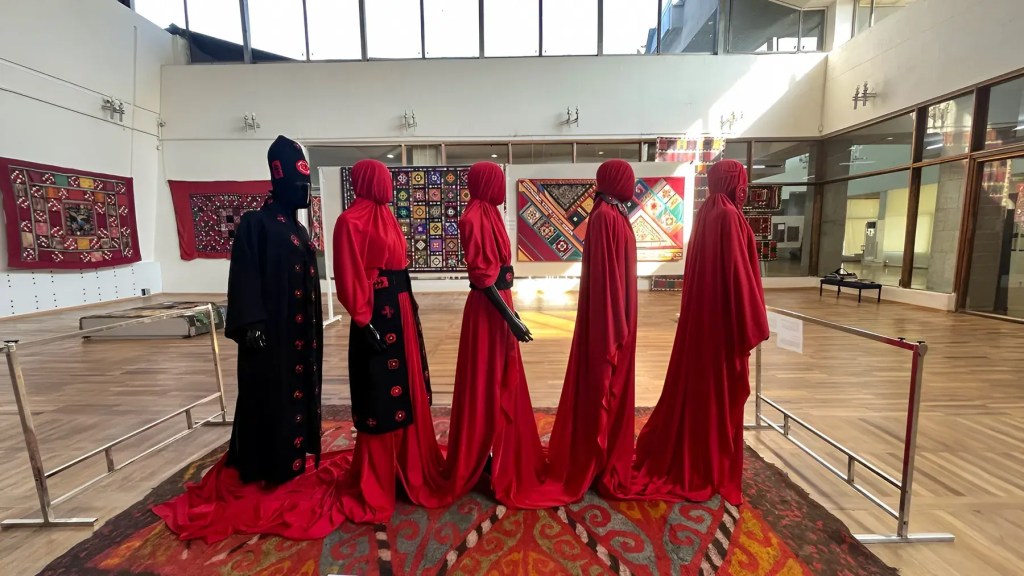
The violence and discrimination that women face in the workplace are central themes in these feminist interventions. The Feminnale exhibition, for example, brought attention to the invisible and unpaid labor of women. The word “feminnale” was created based on the word “biennale” and “feminism” and gathered more than 50 artists from 22 countries. Artworks like Bermet Borubaeva and Polina Nikitina’s ‘iFood || The Third Shift’ exposed the grueling conditions of Central Asian migrant women in Russia’s food industry, who endure low wages, long working hours, and the expectation to perform additional unpaid domestic labor for male relatives. Similarly, Zulya Esentaeva’s performance “Laundrostan” used the metaphor of washing money to critique the exploitation of migrant women, whose backbreaking work sustains families while political elites siphon off wealth into offshore accounts. Aigerim Ospanova’s performance “Action 1”, where she washed animal intestines in cold water—a task traditionally assigned to young brides —serves as a poignant critique of how society relies on women to shoulder the dirty work.
“Throughout the exhibition, artists from all over the world called attention to, problematised and valourised women’s labour, as well as issues of workplace discrimination, harrassment, and pay inequality. Women’s labour comes under multiple forms: the invisible reproductive labour of childbirth and care, nurturing, cooking, cleaning, washing; the emotional labour of maintaining good relationships, creating a positive atmosphere for everyone, always smiling; and the demands on women to perform beauty work by always staying young, attractive, skinny and sexy” wrote Mohira Suyarkulova.
In the exhibition “Timeless Textiles: Kurak – Piecing Together Women’s Stories”, works like Altyn Kapalova and Manshuk Esdaulet’s “Innocent”, which commemorates victims of colonial repression, and the installation “A Slap”, by Altyn Kapalova and Maria Waagbo, address domestic violence. They are illustrating how women’s labor and experiences are intertwined with broader struggles for justice and recognition.
Reinvinting Museum: Museum of Feminist and Queer Art (MoFA+)
As analyzed by Mohira Suyarkulova, the Feminnale faced significant backlash from various conservative groups. Nationalist groups threathened and harrassed the organizers online. The male-dominated Artists’ Union, a professional organization that unites and supports visual artists in the country, promoting their work and contributing to the development of Kyrgyz culture and art, also dismissed the exhibition. The Artists’ Union described feminist art as “secondary” and stated that the exhibition’s performances had “no artistic value” and were “outdated”. The Minister of Culture, Azamat Zhamankulov, also said that the exhibition was an offense to the “traditional” sensibilities of the Kyrgyz people. The Ministry of Culture defended its censorship at the Feminnale as a necessary measure to uphold and preserve “traditional values.” The controversy began with objections to a one-time performance involving nudity, which then extended to the removal of works addressing abortion rights, such as Nadenka’s embroidered underwear marking the legalization of abortion in the USSR and Ekaterina Nesterenko’s “An Ideal Landscape”, which invited women to share their abortion experiences. Other censored pieces included installations using everyday domestic objects, like Elizaveta Neklessa’s “Invisible Work” and the Nadenka collective’s “Happy Holiday! All Rights!”—a washing line with garments embroidered with a timeline of women’s rights milestones, highlighting how recent and incomplete many of these achievements are. Works addressing domestic and sexual violence were also targeted. Zoya Falkova’s “Evermust”, a punching bag shaped like a woman’s torso, and Anya Kislaya’s tapestry “Is Yulia the One to Blame?”—depicting a woman bound in shibari-style ropes, her body covered with offensive words—challenged the normalization of violence against women. The latter included the provocative question: “What do you do when a stop-word does not help anymore?” Additionally, censors banned works exploring women’s bodily autonomy and sexuality, including critiques of beauty standards, harmful cosmetic procedures, and questions about LGBTQ+ rights in Russia. This pattern of censorship revealed a broader effort to silence discussions on gender, sexuality, LGBT experiences and reproductive rights and violence against women.
To counter this silencing, Altyn Kapalova opened the Museum of Feminist and Queer Art (MoFA+), a space where the museum’s artists draw on their personal experiences to address themes such as bodily autonomy, mental health, political engagement, and violence against women.
“Today, the museum is a kind of generator: it produces knowledge, shares information, or sparks protest. The philosophy of our museum is to use art as a tool for social change, as a means of expressing revolt. (…) It became clear that state museums did not want to collaborate,” explains Altyn Kapalova. “So we decided to create our own museum—a museum that would respond to society’s social demands rather than serve those in power. We decided it was time to break away from this patriarchal art that has persisted for millennia and that it was finally time to talk about women artists.”
As we can read in the Guide to museums, galleries exhibition halls of Bishkek, written by Alima Tokmergenova and Alexandra Filatova and edited by Altyn Kapalova, published in 2024, the museum’s mission is structured around five key pillars. First, activism lies at its core: MoFA+ was founded to break the silence and amplify the voices of marginalized artists and pressing social issues, as the museum’s very existence challenges injustice, with silence being the first step toward normalizing oppression. Its advocacy centers on human rights and freedoms, as seen in exhibitions like “Freedom of Speech” (2023). Second, MoFA+ emphasizes the awareness of subjectivity, with the museum’s creators, artists, and collaborators using their work to assert their presence, gain visibility, and provide a platform for women artists through exhibitions, publications, and other forms of artistic expression. Third, MoFA+ functions as a living archive that engages with traditional techniques, drawing on art history and reclaiming methods historically dismissed as “feminine” within patriarchal hierarchies, with craft practices like textile work being integral to its feminist approach and forming a significant part of its collection. Fourth, MoFA+ fosters community support, comprising mostly women who create networks of solidarity through scholarships for female artists, as well as programs and events that connect activists, artists, and audiences. Finally, MoFA+ is committed to research, conducting art expeditions, curating collections, and exploring innovative practices to deepen its impact.
Conclusion
The growing visibility of feminist initiatives in Kyrgyzstan’s museums marks a significant shift in how cultural institutions engage with women’s histories, labor, and experiences. These projects—whether through temporary exhibitions, mobile libraries, or independent spaces like MoFA+—are not only diversifying museum content but also challenging mainstream narratives about art, labor, and history. By centering women’s voices, they expose the structural inequalities embedded in both societal and institutional frameworks, from the gendered division of labor to the erasure of women’s contributions in state-sponsored histories. The case studies highlighted in this post—such as the Nookat tobacco workers’ exhibition, the Timeless Textiles: Kurak project, and the Feminnale—demonstrate how feminist interventions redefine cultural institutions as sites of resistance and reparation. They reveal the complex interplay between state institutions and social movements, where support often coexists with resistance and repression. The censorship of feminist works, the delegitimization of women’s labor, and the struggle for visibility in museum spaces underscore the ongoing battles for recognition and justice. Ultimately, these initiatives are more than just exhibitions or publications—they are acts of reclaiming agency. By integrating feminist, frameworks, museum professionals, scholars, and artists are not only preserving women’s histories but also reshaping the very definition of what a museum can be: a space for activism, a living archive, a platform for marginalized voices, and a catalyst for social change.
Bibliography and ressources
- Altyn Kapalova, Lucia Direnberger et Karim Hammou (2024), L’art du kurak: tisser les histoires des femmes au Kirghizstan, https://ifeac.hypotheses.org/15087
- Kanaiym Kydyralieva et Lucia Direnberger, (2025). Knowledge Production beyond Academia. Bishkek School of Contemporary Art (BiSCA). https://ifeac.hypotheses.org/17667
- Elena Kolesova, Baktygul Midinova, Diana Ukhina, Aleksandra Filatova, Aida Alymova and Altyn Kapalova (2023), session “Representation of Women’s Art and Women’s Stories in Museums in Kyrgyzstan”, conference ‘Life in Kyrgyzstan’, https://youtu.be/E77CEr5o-Ow?si=ZQfsaEV601qPy-3P
- Mohira Suyarkulova (2020), “Fateful Feminnale: an insider’s view of a “controversial” feminist art exhibition in Kyrgyzstan, openDemocracy, Fateful Feminnale: an insider’s view of a “controversial” feminist art exhibition in Kyrgyzstan
- Alima Tokmergenova and Alexandra Filatova (2024), Guide to museums, galleries, exhibition halls of Bishkek, Bishkek: University of Central Asia. https://ucentralasia.org/media/d2wbcmpu/museums-bishkek-eng-2024.pdf
To quote this text : Lucia Direnberger, 2026, “Can Museums Be Feminist? Practices from Kyrgyzstan”, MAJIC – Memories, Arts and Social Justice in Central Asia, https://majic-project.net/2026/05/02/can-museums-be-feminist-practices-from-kyrgyzstan/
 MAJIC
MAJIC 