
Data art, infographics, 2026
Meerim Emil kyzy
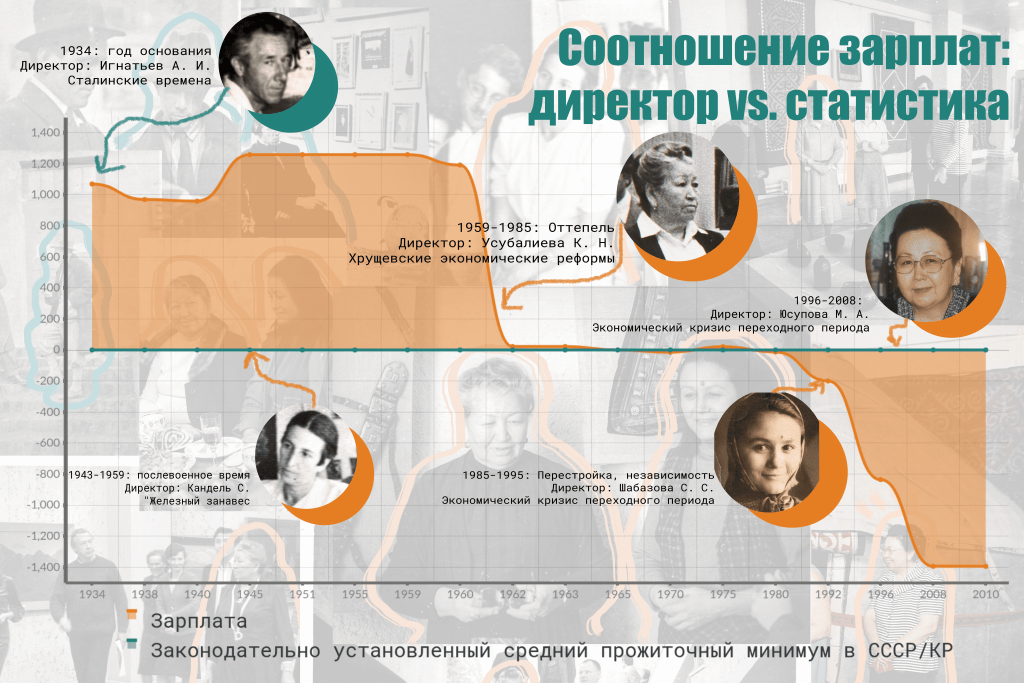
The work is based on data on the ratio of museum director salaries to the national average. The data reveals a dramatic shift in the economic gap between managerial positions and everyday income: before 1963, director salaries were ten times higher than the average (1,300 Soviet rubles compared to 41 Soviet rubles for an ordinary worker). However, Khrushchev’s economic reforms placed political workers (including museum staff) on equal footing with other workers in all sectors, lowering their salaries to the average. After a relatively long period of fluctuation around the average salary, we see a sharp decline with the advent of independence, and the gap has continued to grow steadily since then. Portraits of directors, used as a visual backdrop, add historical and human perspective to the work, making the changes in the data more illustrative. The work is based on data from the archives of the G. Aitiev Kyrgyz National Museum of Fine Arts and the Central State Archives of the Kyrgyz Republic.
Disclaimer: The figures on the chart have been recalculated according to purchasing power in the given year.
“The primary complaint of every single employee is that the salaries are low, like they are dangerously low, sometimes even lower than the minimum wage. (…) Sometimes there is not enough money even to buy food properly, especially if you are not alone and you have family to provide to.
When it was male dominated field, the salaries were good and when the hardship started, especially during the Cold War and the after war period it was a woman who steeped in and pulled the museum through those difficult times.”
🎧 Meerim Emil kyzy :

